Celebrating Our Indigenous Heritage
August 30 to September 3, 2017
Brooklyn, New York
Timehri petroglyphs and Guyanese style: The ancient petroglyphs and their contemporary incarnations have a special place in the Guyanese psyche. They symbolize longevity and the long rootedness of humanity—a special pulse in the Guyanese spirit. It is national identity.






"Pisces" from Gaskin and Jackson's Amazodiac line (2017). Photograph courtesy of Han Granger-Gaskin To close: The ancient petroglyphs and their contemporary incarnations have a special place in the Guyanese psyche. They symbolize longevity and the long rootedness of humanity—a special pulse in the Guyanese spirit. It is national identity. Treasure the heritage ...
In 2017, the motif is still incorporated into Donna Ramsammy-James’ designs and in jewelry, as is evident in Gaskin and Jackson’s current Amazodiac line. "Capricorn" from Gaskin and Jackson's Amazodiac collection (2017). Photograph courtesy of Han Granger-Gaskin
From a 2015 fashion show of Donna Ramsammy-James’ designs. Photograph by Vibert Cambridge
Design by Donna Ramsammy-James’ (2005).
Leather belt made in Guyana (circa 2010). From Donna Ramamsammy-James’ collection. Photograph courtesy of Donna Ramsammy-James.
Earrings designed by Donna Ramsammy-James and made by Magarita’s Gift Shop, Georgetown, Guyana (2001)

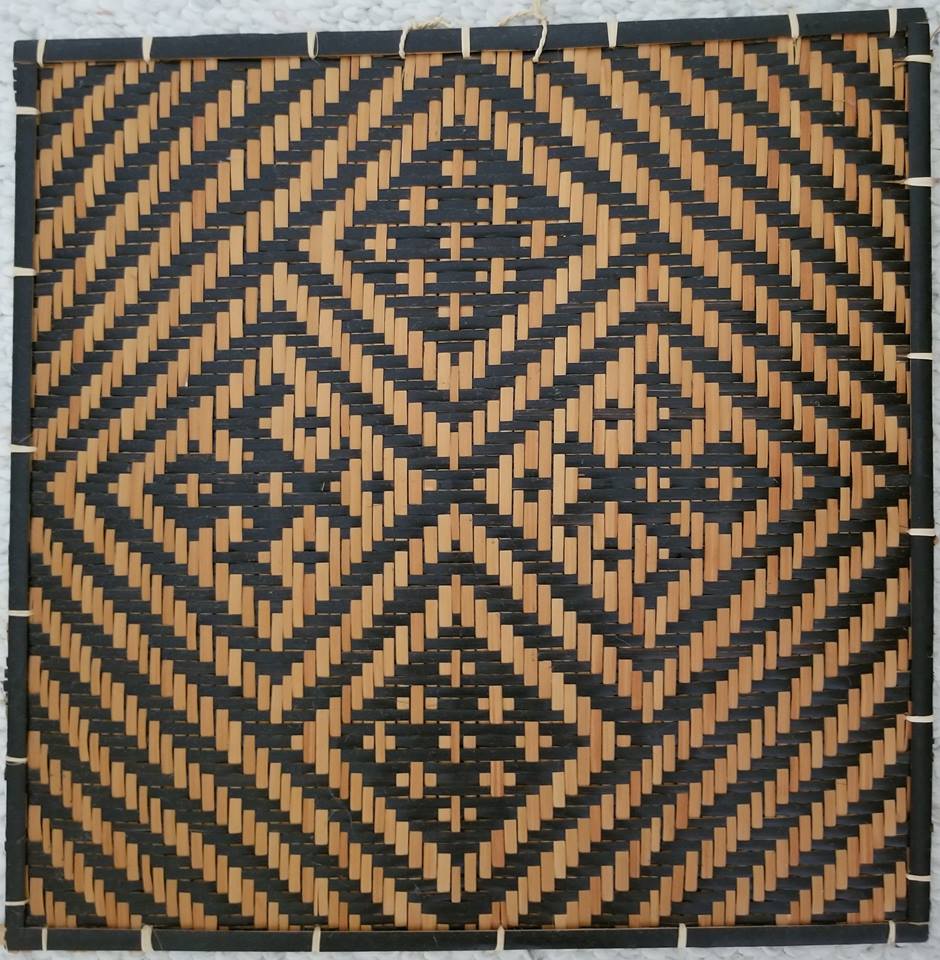
FASHION In the early post-independence years, Guyanese fashion designers incorporated Timehri motifs in clothing. The Timehri motif represented a new day—a new beginning and an expression of national pride and identity. It was part of the Cacique heritage—our indigenous leadership symbol. Donna Ramsammy-James has been incorporating the motif in her designs over the past three decades. Here are examples of her clothing and accessories: Donna Ramsammy-James, choreographer, designer, and an international creative consultant (GCA Awardee, 2009) — with Shape Custom Creationz.
CERAMICS Dinner plate from Vanceram Tableware Factory (mid-1980s). Photograph courtesy of Vibert and Patricia Cambridge
Another wall hanging from House Proud (circa late 1970s-mid-1980s). Photograph courtesy of Vibert and Patricia Cambridge
HOME DECORATIONS House Proud Home furnishings were also influenced by the indigenous aesthetic in the early post-independence era. Here is an example of a wall hanging. Photograph courtesy of Vibert and Patricia Cambridge
JEWELRY Gaskin and Jackson Jewelers Gaskin & Jackson Jewellers was established in 1969 by Herman G. Gaskin and Elric A. Jackson. The company is recognized as the launchers of the Timehri design jewelry. From its inception, the company has produced rings, earrings, pendants, chain, bracelets, cuff links, brooches/pins, and other jewelry inspired by the Timehri Series. Bracelet by Gaskin and Jackson (circa 1970s). Photograph courtesy of Ave Brewster-Haynes.
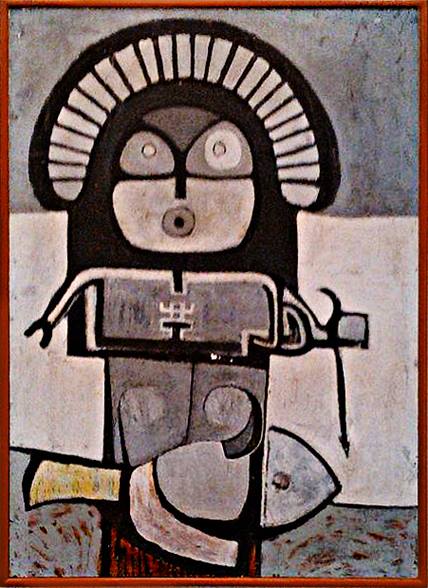
The Timehri Motif The early post-independence years saw a blossoming of this tendency among Guyanese visual artists. The Timehri motif was evident in the paintings of Donald Loncke, Stanley Greaves, and Aubrey Williams; the designs emanating from Design and Graphics; the ceramics of Stephanie Correia and Vanceram; household furnishings (House Proud); the jewelry of Gaskin and Jackson; and clothing of the era. Timehri Man Shooting Fish (1967) by Donald Loncke. Photograph retrieved online at http://www.guyanatimesinternational.com/?p=19387
Enumerative Tradition/Series in petroglyphs in Guyana.
In his book, Prehistoric Guiana, Denis Williams proposed that the petroglyphs found in Guyana were created during the Archaic period (circa 7000 b.p.). According to Williams, the petroglyphs represent evidence of ancient migrations, settlement, and the state of human development. He discerned three traditions or series in the petroglyphs found in Guyana—Enumerative, Fish Trap, and Timehri. The first two are associated with subsistence lifestyles. The last refers to the horticultural period, characterized by the cultivation of cassava.
The Enumerative Series is the older of the three traditions and fall into two categories—the biomorphic and geometric.
Williams provided the following illustrations of petroglyphs from the Enumerative tradition
The Fish Trap petroglyph series are younger than those of the Enumerative series. Louisa Daggers with what appears to be a Fish Trap petroglyph at Aishalton Survey 2016. Photo courtesy Louisa Daggers, Amerindian Research Unit, University of Guyana — with Louisa Daggers.
Timehri Petroglyphs Williams considered the youngest series, the Timehri petroglyphs to be “a representation of an identifiable deity, the Manioc Mother described in a fertility dance.” Louisa Daggers highlighting Manioc Mother petroglyph, Aishalton Survey 2016.
Examples of Timehri petroglyph stereotypes in the Orinoco Basin. From Denis Williams, Prehistoric Guiana, p. 238.
Archaic occupation of the Guianas. From Denis Williams, Prehistoric Guiana, p. 91.
Mapping Our Indigenous Heritage
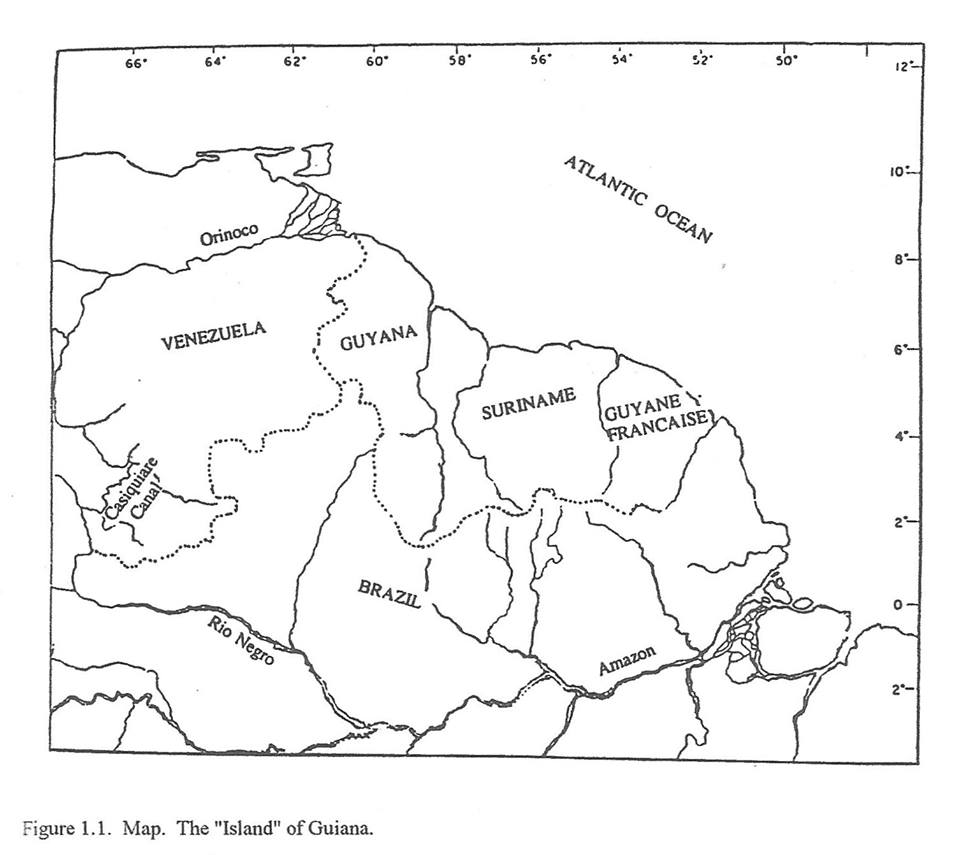
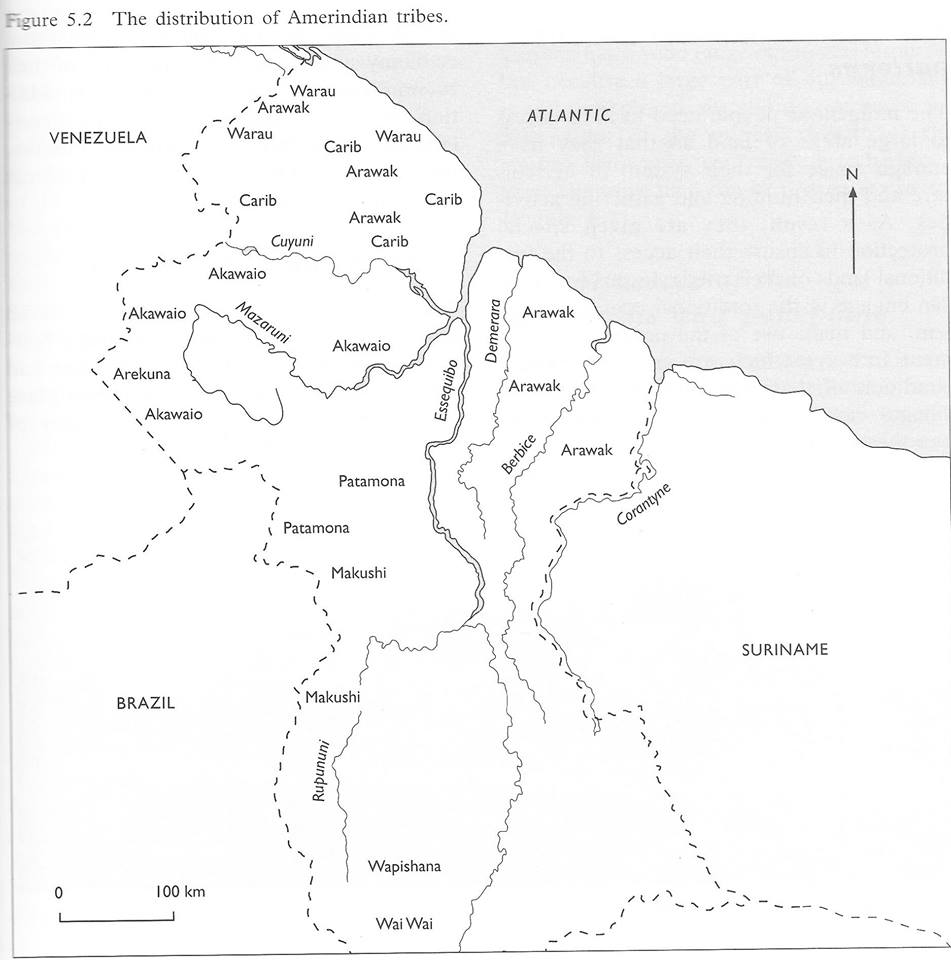
Over the next few months we will be posting materials as contributions to the exploration of our indigenous heritage. Here are three maps from publications by Deryck Bernard, Denis Williams, and Neil L. Whitehead.